
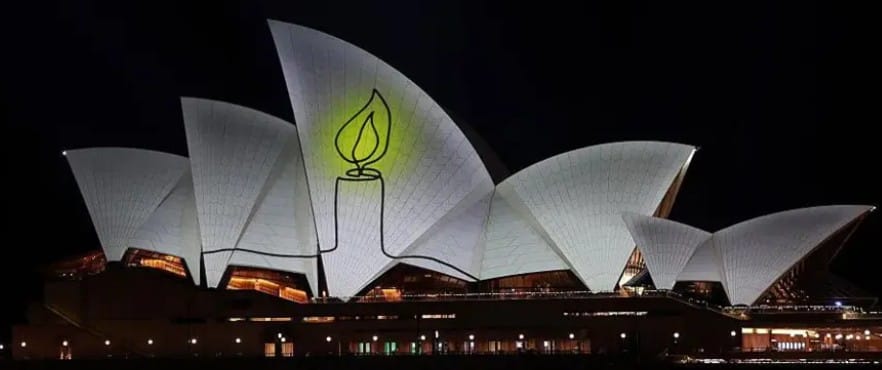
For years, Bondi has sold a certain Australian dream to the world: sunlit waves, sand packed with backpackers, and a sense that whatever chaos the world is engulfed in, here you are safe.
That illusion has been torn open twice in 18 months.
In April 2024, a man in psychosis went on a stabbing rampage through Westfield Bondi Junction, killing six people and injuring many more. On 14 December 2025, as families gathered for a Chanukah event on Bondi Beach, two gunmen opened fire on the crowd, murdering 15 people, including a 10-year-old girl and a beloved local rabbi, and injuring dozens.
For locals like “Mary”, a UK expat who survived the Westfield stabbings and then found herself listening to helicopters and sirens screaming over Bondi again, it felt like a nightmare repeating itself. The country that she had always described to her family as “so safe” suddenly looked and sounded very different.
Australia is now being forced to confront a difficult truth: it was never on holiday from history. Violence, extremism and hatred are not just imported problems. They can be grown here too.
Two tragedies, one community
The Bondi Junction stabbings were shocking partly because of their randomness. A lone attacker, later confirmed to have schizophrenia, moved through a shopping centre with a knife, targeting women and killing five, along with a male security guard. The inquest has already raised serious questions about mental health care – particularly the decision to reduce his medication with limited follow-up – and the families of victims have called for major investment in psychiatric services.
The Chanukah shooting was different. It was not random; it was aimed.
Two gunmen opened fire on a Jewish celebration, killing 15 people and wounding more than 40 in what police and the federal government have formally labelled an Islamist-inspired terror attack linked to Islamic State ideology. The victims included Holocaust survivor Alex Kleytman, whose life began and ended with antisemitic violence, and Rabbi Eli Schlanger, known locally as “the Bondi rabbi”.
The same paramedic who walked into the blood-soaked aisles of Westfield in 2024 was the first to reach the carnage on Bondi Beach. Health officials have described the wounds as “like a war zone”, and frontline clinicians are now carrying the images of two mass-casualty scenes in the same suburb in less than two years.
The psychological impact on the community is profound:
- Survivors of the first attack reliving their trauma as sirens and helicopters return
- Jewish residents who came to Bondi over decades seeking safety from persecution abroad now feeling exposed on their own streets
- Locals who used to swim every day suddenly unable to step into the water because it feels wrong, or even “sacrilegious”, in the shadow of the massacre
When a beach that once symbolised freedom and peace becomes the backdrop to terror, it changes how a nation sees itself.
Antisemitism warnings: heard, logged – or ignored?
Jewish organisations have been warning for months about a sharp rise in antisemitic incidents since the war in Gaza erupted. National monitoring shows anti-Jewish hate in Australia running at around three times pre-October-2023 levels, with a particular increase in vandalism and arson attacks.
In the suburbs around Bondi, that has meant synagogues, schools and Jewish homes repeatedly targeted with graffiti, vandalism and occasional attempts at arson. For many community members, the Chanukah attack felt not like a bolt from the blue, but like the horrific culmination of a pattern they had been pleading with authorities to take seriously.
Their anger is directed in several directions:
- At governments, for being slow and sometimes visibly uncomfortable in naming antisemitism directly.
- At law enforcement and intelligence agencies, after it emerged that at least one of the alleged attackers had previously appeared on a security watch list but was later assessed as a low risk.
- At protest policing, where the gap between protecting free speech and tolerating open hate has sometimes been handled clumsily.
Australia’s Jewish leaders are not alone in their concern. A recent global report by the J7 group of major Jewish communities warned that antisemitism has surged across democracies since October 2023, with Australia among the countries seeing sustained increases.
Against that backdrop, the Bondi shooting feels to many like the moment when warnings turned into tragedy.
Politics, Palestine and the risk of weaponised grief
At the same time, another truth sits uneasily alongside these fears: criticism of Israel’s actions in Gaza, and solidarity with Palestinian civilians, are legitimate political expressions – and many Australian Muslims and non-Jewish allies have protested peacefully and consistently against the war.
In September 2025, the Albanese government formally recognised the State of Palestine, aligning its policy with the UK and Canada. Some Jewish Australians now see that decision through the lens of Bondi, arguing it emboldened anti-Jewish voices. Others, including some within the Jewish community itself, warn against using the attack as a political cudgel to delegitimise Palestinian statehood or portray all pro-Palestinian protest as inherently antisemitic.
This is where the line becomes dangerously blurred:
- There have been protests where chants and placards crossed from criticism of Israeli policy into ugly, classic antisemitic tropes.
- There have also been large, peaceful demonstrations focused squarely on civilian suffering and international law.
The New South Wales government has responded by promising to criminalise “hateful” chants and give police wider powers over protests. Whether those laws are carefully targeted at genuine incitement or drift into suppressing legitimate dissent will be a critical test of Australia’s commitment to free expression.
As one local psychologist put it, Australians are going to have to learn to “hold multiple truths at once”: to acknowledge that antisemitic rhetoric has grown louder in some circles, and that Muslim and Arab Australians are themselves fearful of being collectively blamed for an act of terror they emphatically condemn.
Intelligence failures – and a review that may not be enough
In the aftermath of the attack, Prime Minister Anthony Albanese ordered a review of federal intelligence and policing processes, to be led by former senior official Dennis Richardson. It will examine how agencies like ASIO and the AFP assessed the threat posed by the alleged shooters, and why warning signs were not acted on more forcefully.
Jewish groups and some opposition politicians, however, have called for a full Royal Commission – a far more powerful, public and independent inquiry. So far, Albanese has resisted, opting for a narrower executive review.
That decision has landed badly at Bondi’s vigils. The prime minister was loudly booed at a national memorial, a rare and pointed rejection of a leader at a moment that is usually politically unifying.
The government has also announced a national gun buyback and hinted at tightening loopholes that allowed the attackers to obtain military-style weapons despite Australia’s famously strict gun laws. The uncomfortable reality is that the Howard-era gun reforms, long held up as a global model, were not an absolute shield. For many Australians, that is another myth punctured.
The question now is whether the review will be transparent enough to restore trust – or whether a perception of institutional self-protection will deepen the sense of abandonment already felt by many Jewish Australians.
Media, trauma and the ethics of the spotlight
Another raw nerve in Bondi is the media.
In the days after the shooting, traumatised survivors were interviewed live on television while still spattered with blood from helping the wounded. Some Jewish and Arab Australians alike feel their communities have been caricatured: Jews as monolithic supporters of every Israeli policy, Muslims as potential sympathisers with terror.
Those grievances matter. When people already feel targeted, coverage that trades nuance for drama can harden suspicion – not just towards media organisations, but towards the wider public they speak to.
There is a legitimate public interest in understanding what happened, how security failed, and how communities are coping. But there is also a duty of care. Asking shattered people to perform their grief in real time, before they have even processed what they’ve seen, is not accountability; it’s spectacle.
A nation between fear and defiance
For all the anger and anxiety, there have also been vivid acts of solidarity:
- Lifeguards and surf lifesavers running towards gunfire to pull people to safety
- Restaurant owners hiding terrified families in back rooms and freezer units
- Long queues outside blood donation centres as thousands of Australians gave what they could
- Surfers and swimmers paddling out beyond the Bondi breakers in a silent tribute to the dead
At a deeply emotional candlelit memorial a week after the shooting, a large menorah was finally lit – a ritual that the Chanukah crowd on the beach never got to complete. Candles were kindled by the father of hero Ahmed al-Ahmed, who helped wrestle a gun away from one attacker; by the children of rabbis who were killed; by surf lifesavers, medics and the father of the youngest victim, Matilda.
Rabbi Yehoram Ulman told the crowd that simply “returning to normal” was not good enough. Sydney, he argued, needed to become “a beacon of goodness… where kindness is louder than hate, where decency is stronger than fear” – but only if the emotions of this moment are turned into sustained action, not just a wave of flowers and hashtags.
That raises the final, hardest question.
Where does Australia go from here?
If these twin tragedies are to mean more than grief and anger, they demand changes on multiple fronts:
- Mental health and prevention
The Bondi Junction stabbings exposed dangerous gaps in psychiatric care and follow-up. The coronial process should not end with blame for one doctor; it must drive long-term investment in community mental health, crisis intervention and systems that catch people before they spiral into violence. - Counter-extremism with accountability
Bondi Beach shows that Islamist extremism can take root even under strict gun laws and close ASIO scrutiny. The promised review must be honest about what was missed, how risk assessments are made, and whether community warnings – from both Jewish and Muslim leaders – are treated with the seriousness they deserve. - A sharper line on hate – and a firmer defence of free speech
Australia will need laws and policing that can crack down on genuinely inciting chants and symbols without equating every critic of Israeli policy with a bigot. That requires political courage and precision, not culture-war point-scoring. - Media responsibility
Newsrooms need to look hard at how they cover mass violence – especially in diverse communities already feeling under siege. Trauma-informed reporting and a commitment to nuance are not luxuries; they are part of rebuilding trust. - Community-led healing
The most powerful responses so far have come from ordinary people: the beach paddles, the blood donations, the multi-faith menorah lighting. Governments can fund programs and reviews, but they cannot legislate the neighbourly instinct that saw strangers shelter children in their flats. Bondi will need more of that – and so will the rest of Australia.
The easy story Australia used to tell itself was that these things happened somewhere else. That story is gone. What replaces it will depend on whether the country responds with fear and division, or with the kind of stubborn, practical solidarity that Bondi’s best moments have already sho