
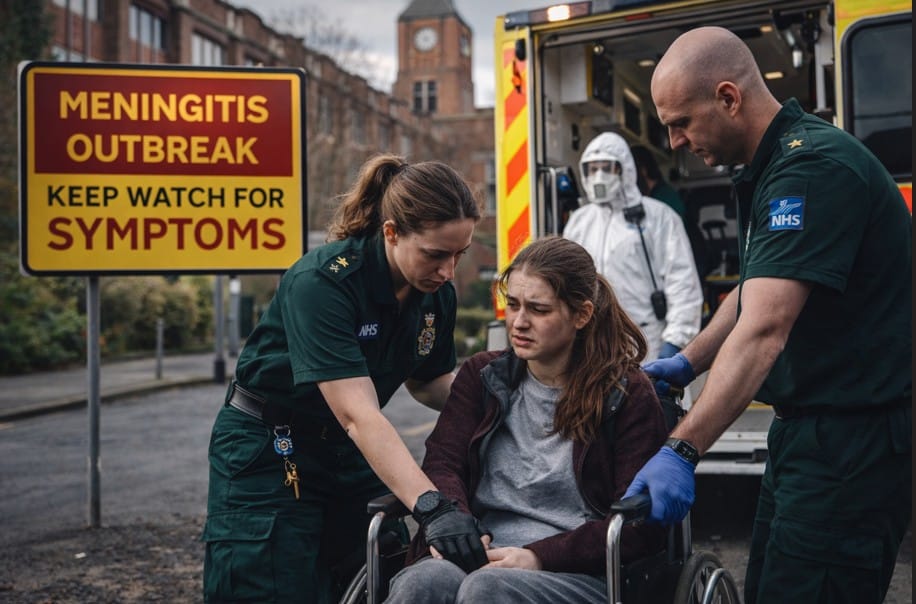
Canterbury is reeling after reports of an “invasive” meningitis outbreak linked to the University of Kent area, with two deaths confirmed and a further 11 people reportedly seriously ill in hospital. Public health officials are now contacting tens of thousands of students, staff and families, while arranging preventive antibiotics for close contacts—a sign that authorities believe this is a fast-moving situation where early intervention matters.
But the most important detail is also the most unsettling: the exact strain has not yet been publicly identified, which means the response must assume urgency while the science catches up.
The truth so far: why officials are acting fast
“Invasive” meningococcal disease is a phrase used when the bacteria move beyond mild illness and enter the bloodstream or the central nervous system. That’s when it can become meningitis, septicaemia (blood poisoning), or both—conditions that can deteriorate frighteningly quickly.
That’s why the UK Health Security Agency (UKHSA) focus is not mass messaging alone, but targeted contact tracing—identifying people most likely to have had close exposure and giving them antibiotics as a precaution.
The setting also matters. University life concentrates risk factors in one place: shared accommodation, crowded social events, late nights, and close-contact mixing. Health experts and charities repeatedly warn that student environments can amplify spread, and symptoms can be dismissed as “freshers’ flu” or even a hangover.
What makes this outbreak especially worrying
This isn’t just a case count story—it’s a speed story.
Public guidance is consistent: meningitis/sepsis can get worse rapidly, and you should not wait for every symptom to appear or for a rash to develop. The NHS advice is clear: if meningitis or sepsis is suspected, call 999 or go to A&E immediately.
The well-known “glass test” (checking whether a rash fades under pressure) is still relevant—but it’s not the only red flag. UKHSA and meningitis charities also highlight earlier signs like severe limb pain, cold hands and feet, confusion, extreme sleepiness, and fast breathing.
The critics’ questions: what people will challenge in the days ahead
Even with a rapid response, outbreaks like this inevitably trigger difficult scrutiny. Here are the main pressure points—and the fair way to view them:
1) “Why wasn’t this prevented?”
Critics will ask about vaccine coverage and whether students arrived on campus protected. The MenACWY vaccine is recommended for under-25s starting university, and the NHS advises getting it ideally before term—or as soon as possible if you’ve already started.
But vaccination protection is not one-size-fits-all: different meningococcal groups exist, and not every strain is covered by the same programme. That’s why identifying the strain matters.
2) “Was the university quick enough to warn people?”
Students and parents often judge institutions on speed and clarity: where to go, what to do, whether teaching continues, and how to access antibiotics. Universities typically must balance urgency with accuracy—especially before a strain is confirmed—yet silence (or slow messaging) can create panic and misinformation.
3) “Is the health system prepared for campus outbreaks?”
Local NHS services can be strained when many young adults present with fever/headache at once, especially when symptoms overlap with flu-like illness. This is where public health triage and clear NHS guidance becomes crucial: call 111 for advice if unsure, but do not hesitate if someone is seriously ill.
4) “Are we underestimating how quickly student illness spreads?”
If the outbreak is linked to a social event, critics will argue that student cities need stronger outbreak playbooks—rapid communications, temporary event restrictions, and easier access to vaccination checks and GP registration.
What students and families should do right now (practical, evidence-based)
This is not about alarm—it’s about speed and clarity.
- Know the symptoms: fever, severe headache, vomiting, stiff neck, sensitivity to light, confusion, drowsiness, cold hands/feet, limb pain, rapid breathing.
- If you suspect meningitis or sepsis: call 999 or go to A&E—don’t wait.
- Check MenACWY status if you’re under 25 and starting university; the NHS says to ask a GP or campus health centre.
- Don’t rely on the rash: it may appear late or not at all, and on darker skin it can be harder to see.
The bigger picture: the quiet lesson for the UK
This outbreak is a reminder that modern public health isn’t only about hospitals—it’s about density. Universities are mini-cities with their own social networks, living arrangements and behaviours, and that makes them uniquely vulnerable to fast-spreading infections.
The UK’s test now is whether the response can stay ahead of the disease: identify the strain, break transmission chains, support families, and communicate consistently enough that students take symptoms seriously without sliding into panic.
For Canterbury, the coming days will be measured in two currencies: time—and trust.