Europe’s leaders have drawn a rare collective line in the snow. As US President Donald Trump threatens sweeping tariffs against key allies over Greenland, the response from Europe has been unusually blunt: this is not negotiation, it is coercion.
At the centre of the standoff lies Greenland — an autonomous territory of Denmark, sparsely populated but strategically priceless. Trump has framed control of the island as essential to US security, warning that countries opposing his plan could face punitive tariffs as early as February. He has even declined to rule out the use of force — rhetoric that has alarmed allies across Nato.
Denmark’s Prime Minister Mette Frederiksen captured the continental mood succinctly:
“Europe will not be blackmailed.”
The Threat: Tariffs as a Weapon of Influence
Trump has threatened to impose 10% tariffs — potentially rising to 25% — on eight allied nations, including Denmark, France, Germany, Sweden, Norway, the Netherlands, Finland and the UK. The justification, he claims, is global security.
Yet European governments see something far more troubling: the use of economic punishment to force political compliance within an alliance built on shared defence and sovereignty.
In a rare joint statement, the targeted countries warned that Trump’s approach risks a “dangerous downward spiral”, undermining the foundations of transatlantic cooperation.
They reiterated their full solidarity with Denmark and Greenland, while affirming that Arctic security must be addressed collectively through Nato, not by unilateral pressure.
Why Greenland Matters — and Why Europe Is Alarmed
There is no denying Greenland’s importance. Sitting between North America and the Arctic, the island plays a critical role in missile early-warning systems, satellite tracking, and Arctic maritime surveillance. It is also rich in rare earth minerals and increasingly exposed as ice melts open new shipping routes.
But critics argue Trump’s framing — that Greenland “must” belong to the US to be secure — dangerously rewrites post-war norms.
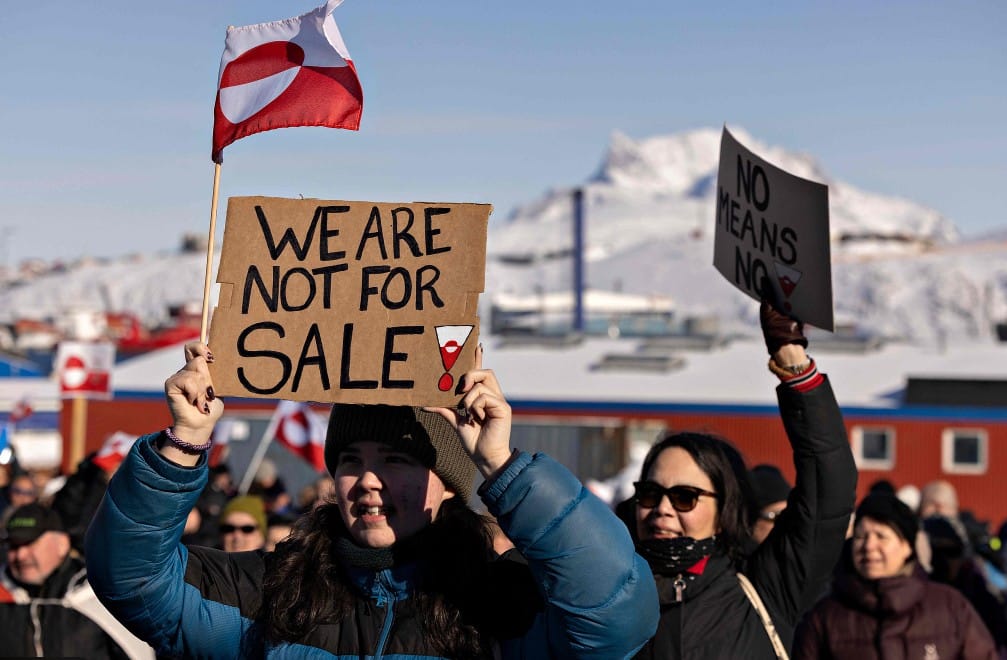
Greenland’s own population overwhelmingly rejects the idea. Polling shows 85% of Greenlanders oppose joining the US, with protests erupting in Nuuk and Copenhagen under banners reading “Greenland for Greenlanders.” Even in the US, public support is weak, with most Americans opposing the takeover.
To European leaders, this makes Trump’s insistence less about defence and more about geopolitical leverage.
Britain and Nato: Caught Between Alliance and Alarm
UK Prime Minister Keir Starmer has been working behind the scenes, holding calls with Frederiksen, European Commission President Ursula von der Leyen, and Nato Secretary-General Mark Rutte before speaking directly to Trump.
Downing Street stressed that while Greenland’s security is a shared Nato concern, punishing allies for upholding collective defence principles is fundamentally wrong.
France’s President Emmanuel Macron has gone further, signalling that the EU could activate its anti-coercion instrument, a powerful trade defence mechanism designed to counter economic intimidation.
Truth vs Critics: Security or Strong-Arm Politics?
The truth:
Greenland’s location matters. Arctic militarisation is accelerating. Russia and China are expanding their presence, and Nato nations must invest more in northern defence.
The criticism:
Trump’s approach risks collapsing trust inside Nato by treating allies as adversaries. Economic threats against partners defending international law blur the line between cooperation and coercion — and weaken the very alliance the US relies upon.
Former diplomats warn this moment could mark a turning point: if sovereignty becomes negotiable under tariff pressure, smaller states may begin questioning the reliability of collective defence altogether.
A Wider Signal in a More Contested World
The timing is striking. Trump is due to address the World Economic Forum in Davos under the banner of “cooperation in a contested world.” Yet Europe sees a contradiction between that theme and the threat of trade warfare against allies.
Canada, too, has expressed concern, announcing increased Arctic investment while stressing that Nato unity remains the only credible path to regional security.
Europe Draws a Line
This dispute is no longer just about Greenland. It is about whether alliances are built on mutual respect or transactional pressure.
Europe’s response suggests a recalibration is underway. The continent is signalling that it will defend sovereignty, resist economic intimidation, and — if necessary — use its own trade tools to respond.
Whether Trump backs down or escalates, one thing is clear: the Arctic has become a geopolitical fault line, and how it is handled may shape the future of the transatlantic relationship itself.