
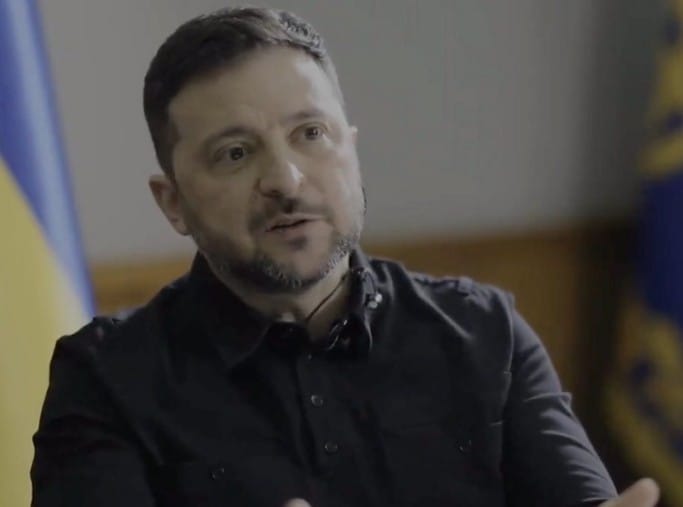
In Kyiv’s fortified government quarter, President Volodymyr Zelensky delivered a message designed to travel far beyond Ukraine’s front line: Ukraine is not “losing,” it will not trade away strategic ground for a pause, and any settlement that demands withdrawals from areas Russia has not captured would be less a compromise than an abandonment. The words land in a Europe that is simultaneously exhausted by war, alarmed by escalation, and newly unsure how long Washington will hold the line.
But beneath the rhetoric sits a colder reality: battlefield geometry, manpower and munitions constraints, and the political limits of Western unity. Zelensky’s defiance is not merely an emotional posture—it is a negotiating strategy. Yet it also carries risks: for Ukrainian cohesion, for European security planning, and for the credibility of any future diplomatic “off-ramp.”
What Zelensky is really saying—and what it signals
Zelensky’s rejection of territorial concessions is framed not as a cartographic argument but a societal one: territory is people, and withdrawal would fracture the country internally. That emphasis matters. It’s a reminder that “land for peace” isn’t an abstract bargain when hundreds of thousands of civilians remain in occupied areas and millions have already been displaced.
His warning that Vladimir Putin has “already started World War Three” is best read as strategic messaging rather than literal prediction. Zelensky is trying to force European capitals to treat Ukraine as the forward edge of Europe’s own security perimeter—because, in his view, if Moscow is rewarded, the model spreads. European intelligence and security communities have increasingly warned that Russia’s pressure campaign—military, cyber, political, and economic—will persist regardless of how any single negotiation round ends.
The ceasefire problem: a pause isn’t peace
The core dispute is not whether guns could fall silent—it’s whether silence would last.
Recent Geneva talks illustrate the gap. Reporting suggests no decisive breakthrough, with Ukraine dissatisfied and the U.S. presenting the discussions as “meaningful progress.” The sticking points remain the familiar pillars: territory in the east and south, and governance/control questions around critical infrastructure such as Zaporizhzhia.
Zelensky’s fear is straightforward: a ceasefire on Russia’s terms becomes operational reset time. Even if you disagree with his timelines, the logic is widely understood in military planning—pauses are often used to reconstitute units, rebuild stockpiles, rotate forces, and refine tactics.
The “truth test”: what the numbers and maps imply
Two facts shape everything:
1) Russia still holds roughly one-fifth of Ukraine. That does not mean Russia is “winning,” but it does mean the war’s baseline has hardened into a brutal contest of attrition and incremental advances.
2) The front line is not static—yet progress is costly. Independent conflict-tracking analysis has shown Russia making measurable territorial gains over recent weeks, even as Ukraine conducts strikes and localized counter-moves.
This is where Zelensky’s public definition of “victory” becomes carefully calibrated. He argues that returning to Ukraine’s 1991 borders is justice—but not something to be achieved “today” at the price of catastrophic casualties and without sufficient weapons. That’s not a retreat from ambition; it’s an admission of constraints.
The critics’ case: “You can’t win the war you can’t resource”
Outside Ukraine, critics—some sympathetic, some not—say the war’s material balance makes full territorial restoration unlikely without a dramatic shift in Western support or a major Russian political/military shock. Recent commentary and reporting on troop shortfalls and equipment gaps keep feeding this line of argument.
Inside Ukraine, another criticism bites harder: wartime leadership is not the same as wartime governance. Corruption scandals and fatigue can erode the moral clarity that held society together in earlier stages of the invasion. Even when Zelensky’s approval remains comparatively strong by European standards, the direction of travel matters because it affects mobilisation, trust, and resilience.
Zelensky’s counter is essentially: you’re judging outcome without standing in the country that is being attacked. It’s a moral argument—and it resonates—but it doesn’t dissolve the logistics of ammunition, air defence, air superiority, and manpower.
Trump, pressure, and the transatlantic squeeze
The most destabilising variable is the perception that Washington is pressing Kyiv harder than Moscow. This has shown up explicitly around Geneva, where Zelensky has publicly criticised the imbalance of pressure.
The wider historical context matters too. The U.S. has previously paused military aid and intelligence sharing as leverage, then resumed elements of support later—episodes that sent shockwaves through European capitals about strategic dependency.
For Europe, the uncomfortable truth is this: even if European governments increase spending, U.S. systems, U.S. stocks, and U.S. intelligence capabilities remain deeply woven into Ukraine’s defence. When that support becomes conditional or erratic, European leaders inherit crisis-management responsibilities they are not fully tooled up to carry.
Elections: democratic principle meets wartime reality
Calls for Ukrainian elections are presented by some Western voices as a democratic necessity and by Kyiv as an operational risk—because elections during martial law, with millions abroad, occupied territories, and active strikes, could fracture legitimacy rather than renew it.
The truth sits in the collision between ideals and feasibility. Zelensky’s position—security guarantees first, elections once conditions are credible—aligns with a basic governance requirement: the vote must be recognisable as free and fair to be stabilising. Reuters reporting around the talks underscores how central “security guarantees” remain to Kyiv’s willingness to contemplate major political steps.
What Europe should learn from this moment
Zelensky’s interview is a warning flare aimed at Europe as much as Russia:
- A ceasefire without enforceable security guarantees is a bet on Putin’s restraint. Kyiv won’t take that bet—and many European security planners privately won’t either.
- Europe is drifting from “supporting Ukraine” toward “inheriting Ukraine’s security problem.” The more uncertain U.S. policy becomes, the more Europe must decide whether it can deter future Russian aggression with its own instruments.
- Ukraine’s maximal justice claim (1991 borders) and its immediate survival needs (air defence, ammunition, manpower) are not the same fight. Confusing them produces bad policy and louder disappointment.
Bottom line
Zelensky is arguing that the world is treating a continental security crisis like a negotiable border dispute. His critics argue that he is describing an end state Europe cannot currently deliver.
Both can be “true” at once.
The interview’s real message is not that Ukraine will “win tomorrow,” but that Kyiv will resist any deal that trades national cohesion for a temporary quiet. Europe now has to decide whether it agrees—and, if it does, whether it is willing to pay the price of that agreement in money, industry, deterrence, and political unity.